Top-Cited Federal Reserve System Compliance Violations in 2024 Under the Flood Disaster Protection Act
The Flood Disaster Protection Act of 1973 (FDPA)1 requires local communities with a high risk of floods to adopt ordinances to reduce future flood losses and to participate in the National Flood Insurance Program (NFIP) as a condition of receiving federal flood assistance. The FDPA also prohibits regulated lending institutions from making, increasing, extending, or renewing a loan secured by improved real estate or a mobile home that is in, or will be in, a special flood hazard area (SFHA) in a participating community, unless the property securing the loan is covered by flood insurance.2 Loans requiring flood insurance are defined as designated loans in the FDPA’s implementing regulations.3
FLOOD INSURANCE COMPLIANCE VIOLATIONS
Although the FDPA was enacted more than 50 years ago, violations of its requirements regularly appear in the Federal Reserve’s list of top-cited compliance violations. The other federal regulatory agencies that enforce the FDPA also frequently cite these violations. A review of 2024 examination data of state member banks, for which the Federal Reserve is the primary federal regulator, listed the following top-cited violations of Regulation H, the Federal Reserve’s FDPA implementing regulation:
- Originating designated loans with an insufficient amount of insurance
- Failing to provide the required notice to borrowers when they apply for a designated loan
- Failing to identify lapses in coverage and force place insurance when necessary
REGULATORY REQUIREMENTS
Requirement to Purchase Flood Insurance Where Available: 12 C.F.R. §208.25(c)(1)
“A member bank shall not make, increase, extend, or renew any designated loan unless the building or mobile home and any personal property securing the loan is covered by flood insurance for the term of the loan. The amount of insurance must be at least equal to the lesser of the outstanding principal balance of the designated loan or the maximum limit of coverage available for the particular type of property under the Act. Flood insurance coverage under the Act is limited to the building or mobile home and any personal property that secures a loan and not the land itself.”
Failing to Require Sufficient Flood Insurance at Origination
Under the FDPA, flood insurance must be purchased for the lesser amount of the outstanding principal balance of the loan or the maximum amount of insurance available under the NFIP. The maximum amount of flood insurance under the NFIP is $250,000 for residential buildings and $500,000 for nonresidential buildings. Contents coverage is available for up to $100,000 for residential structures and $500,000 for nonresidential structures. However, the maximum amount of coverage available under the NFIP is based on the property’s insurable value, which is discussed later in this article.
Examiners observed that, in most instances, banks understood and complied with Regulation H expectations to require flood insurance for properties located in SFHAs. Violations were most frequently cited because of lender errors that resulted in the borrower purchasing an incorrect amount of flood insurance or in the loan being briefly uninsured post-closing. The root cause of these violations was generally a combination of insufficient policies, procedures, and staff training for determining flood coverage combined with the absence of secondary reviews to ensure lenders accurately calculated the required amount and term.
Change in Consummation Date
During the period from the receipt of an application to loan origination, changes may occur that affect the initial flood insurance estimates. For example, assume a loan requiring flood insurance was initially expected to close on June 30, 2025, but the closing date was subsequently changed to June 10, 2025, to accommodate the buyer. If the bank failed to ensure the policy’s effective date was changed to June 10, 2025, the loan would have been uninsured for nearly three weeks. Examiners observed multiple instances of banks failing to recognize that changing the consummation date affects the date the policy should have become effective.
Calculating the Incorrect Insurable Value
Examiners observed banks failing to accurately calculate the insurable value of property covered by flood insurance, a factor in determining how much flood insurance is required and the amount that would be paid on a claim.
Insurable value is defined as the overall value of the property securing the designated loan minus the value of the land on which the property is located.4 To calculate the amount of required insurance, the lender and borrower (by themselves or in consultation with the flood insurance provider or another appropriate professional) may choose from a variety of ways to establish the insurable value, including:
- an appraisal based on the cost value, not the market value;
- a construction-cost calculation;
- the insurable value used in a hazard insurance policy (recognizing that adjustments may be necessary, as this value does not include the value of the foundation); or
- any other reasonable approach that is supportable.5
Multiple Properties
Examiners observed lenders choosing the incorrect amount of insurance for commercial loans when multiple properties secured the loan. Consumer Compliance Outlook (CCO) published an article in 2022 that included examples of how to calculate the proper amount of insurance when a designated loan is secured by multiple properties. See Danielle Martinage, “Commercial Flood Insurance Compliance — Washing Away Common Pitfalls,” CCO (Second Issue 2022).
Calculation errors were attributed to:
- insufficient understanding of flood insurance calculations at the loan officer level;
- relying on outdated replacement cost values; and
- absence of secondary reviews to identify lender errors.
REGULATORY REQUIREMENTS
Notice of Special Flood Hazards and Availability of Federal Disaster Relief Assistance: 12 C.F.R. §208.25(i)
During origination of a designated loan, a bank must mail or deliver a written notice to the borrower or servicer explaining that, if the property securing the loan is in an SFHA, flood insurance must be purchased. The notice also notifies the borrower that the premiums may be required to be escrowed and that private flood insurance may be available.
Notices must be provided to the borrower “within a reasonable time before the completion of the transaction, and to the servicer as promptly as practicable” after notice to the borrower.
Failing to Provide Notice to Borrowers in a Timely Manner
Banks were cited for failing to provide the required flood insurance notice under 12 C.F.R. §208.25(i) to the borrower when a loan was made, increased, renewed, or extended for real property or a mobile home in an SFHA. A model form of the notice is available in Appendix A to Regulation H.
Lenders were cited for failing to provide the required notice “within a reasonable time.” The 2022 flood insurance Q&As clarified the timing requirements for providing the required notice:
As required by the Regulation, a lender must provide the Notice of Special Flood Hazards to the borrower within a reasonable time before the completion of the transaction. What constitutes “reasonable” notice will necessarily vary according to the circumstances of particular transactions. A lender should bear in mind, however, that a borrower should receive timely notice to ensure that (1) the borrower has the opportunity to become aware of the borrower’s responsibilities under the Act; and (2) where applicable, the borrower can purchase flood insurance before completion of the loan transaction. The agencies generally regard 10 calendar days as a “reasonable” time interval.6
The root causes for notice violations included:
- staff having an inadequate understanding of flood insurance requirements;
- staff failing to adhere to the institutions’ written flood procedures;
- a lack of strong internal controls;
- insufficient sample sizes in insurance monitoring and audits;
- improper documentation; and
- lack of compliance oversight.
REGULATORY REQUIREMENTS
Force Placement of Flood Insurance: 12 C.F.R. §208.25(g)
“Notice and purchase of coverage. If a member bank, or a servicer acting on behalf of the bank, determines at any time during the term of a designated loan, that the building or mobile home and any personal property securing the designated loan is not covered by flood insurance or is covered by flood insurance in an amount less than the amount required under paragraph (c) of this section, then the member bank or its servicer shall notify the borrower that the borrower should obtain flood insurance, at the borrower’s expense, in an amount at least equal to the amount required under paragraph (c) of this section, for the remaining term of the loan. If the borrower fails to obtain flood insurance within 45 days after notification, then the member bank or its servicer shall purchase insurance on the borrower’s behalf. The member bank or its servicer may charge the borrower for the cost of premiums and fees incurred in purchasing the insurance, including premiums or fees incurred for coverage beginning on the date on which flood insurance coverage lapsed or did not provide a sufficient coverage amount.”
Failing to Identify Lapses in Coverage and Force Place Insurance When Necessary
Regular monitoring of loans in SFHAs is recommended to ensure no lapses in coverage occur during the life of the loan. In several instances, banks were cited under 12 C.F.R. 208.25(g) because examiners noted flood insurance had lapsed on designated loans for longer than the regulation permits and the bank failed to force place insurance.
As already discussed, a lender is required to notify borrowers about flood insurance requirements when a designated loan is made, increased, renewed, or extended for a real property in an SFHA. A lender should ensure flood insurance is maintained over the life of the loan through monitoring. If the lender becomes aware a designated loan is uninsured or underinsured at any point, it must notify the borrower to purchase insurance or increase the amount, as applicable, within 45 days. If the borrower fails to do so, the bank must purchase the insurance on the borrower’s behalf.7 When a lender force places flood insurance, it “may charge the borrower for the cost of premiums and fees incurred in purchasing the insurance, including premiums or fees incurred for coverage beginning on the date on which flood insurance coverage lapsed or did not provide a sufficient coverage amount.”8
The root causes for monitoring and force placement violations included:
- failure to monitor loans in SFHAs for adequate flood insurance over the life of the loan;
- audit gaps that limit the bank’s ability to identify uninsured or underinsured loans; and
- insufficient corrective action procedures to prevent identified issues from recurring.
Some sound practices banks can rely on to mitigate this area of risk include:
- using controls to monitor the policy renewal date and ensure the borrower does not let the policy lapse, especially for loans that are not subject to a mandatory escrow of flood insurance premiums and fees;9
- implementing detailed flood training to ensure lenders are aware of life-of-loan coverage requirements and force placement provisions;
- periodically reviewing Federal Emergency Management Agency (FEMA) flood maps to identify if any loans are in SFHAs as a result of map changes; and
- hiring a third-party vendor to conduct life-of-loan monitoring and notify the bank of any changes in flood maps.
GENERAL SOUND PRACTICES TO MITIGATE COMPLIANCE RISKS
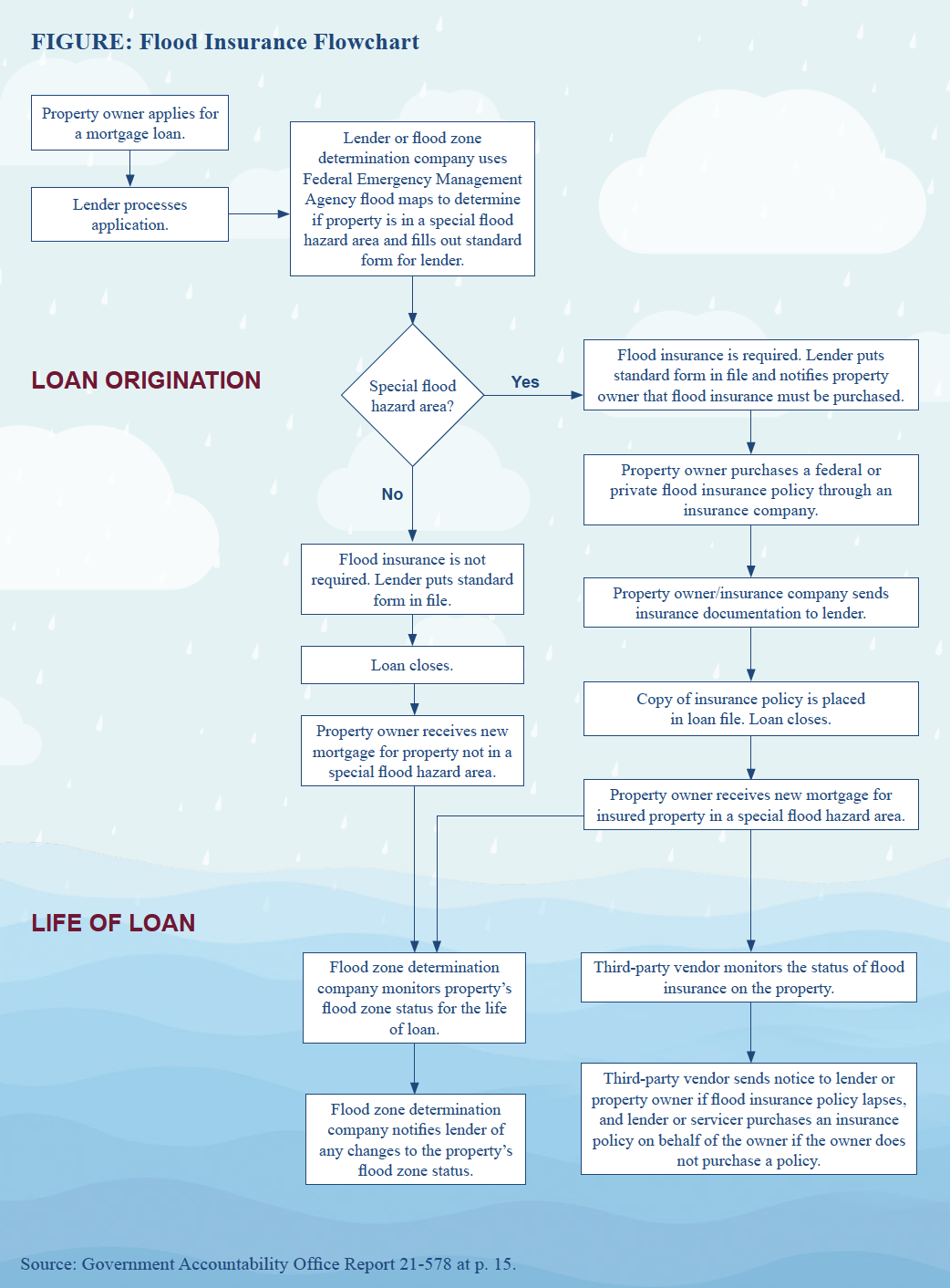
Most of the violations already discussed occurred because of gaps in policies and procedures related to flood insurance requirements, inadequate secondary review processes, and limited risk monitoring for adequate coverage over the life of the loan. The table lists compliance practices examiners have observed and recommend, and the figure provides a flood insurance flowchart with an overview of the compliance process.
TABLE: Sound Compliance Practices
|
Board and Senior Management Oversight |
|
|
Internal Controls |
|
|
Training |
|
|
Monitoring and Audit |
|
|
Policies and Procedures |
|
CONCLUDING REMARKS
It is important for financial institutions that originate or purchase loans subject to the FDPA to have a strong flood insurance compliance management system in place. This article discussed common violations among Federal Reserve–regulated institutions and sound practices to mitigate the compliance risks. Lenders should raise specific issues and questions about FDPA requirements with their primary regulator.
Resources
- Outlook Live webinar, “Flood Insurance Compliance – Examiner Insights,” November 19, 2025
- Kenneth J. Benton, “Overview of Private Flood Insurance Compliance Requirements,” CCO (First Issue 2024)
- Danielle Martinage, “Commercial Flood Insurance Compliance — Washing Away Common Pitfalls,” CCO (Second Issue 2022)
- “Compliance Alert: FEMA Begins Risk Rating 2.0 Flood Insurance Initiative,” CCO (Fourth Issue 2021)
- Danielle Martinage, “Vendor Management Considerations for Flood Insurance Requirements,” CCO (Second Issue 2019)
- “Interagency Flood Insurance Regulation Update Webinar: Questions and Answers,” CCO (First Issue 2016)
- Blessing Chimwanda and Danielle Martinage, “Agencies Issue Final Rule for New Flood Insurance Requirements,” CCO (Third–Fourth Quarter 2015)
- Kenneth J. Benton, “Flood Insurance Compliance Requirements,” CCO (Third–Fourth Quarter 2015)
ENDNOTES
1 Public Law 93–234, 87 Stat. 975 (December 31, 1973). Codified, as amended, at 42 U.S.C. 4002 et seq.
2 42 U.S.C. §§4002(b), 4012a(b).
3 12 C.F.R. §208.25(b)(5). The FDPA’s implementing regulations are issued on an interagency basis but are separately codified in each agency’s regulations: Federal Reserve: Regulation H, 12 C.F.R. §208.25; Farm Credit Administration: 12 C.F.R. Part 614, sub-part S; Federal Deposit Insurance Corporation: 12 C.F.R. Part 339; National Credit Union Administration: 12 C.F.R. Part 760; and Office of the Comptroller of the Currency: 12 C.F.R. Part 22. For convenience, this article cites the Board’s regulations, but the other agencies’ regulations are substantially similar.
4 Interagency Questions and Answers Regarding Flood Insurance, Q&A Amount 1, 87 FR 32826, 32878 (May 31, 2022).
5 Interagency Questions and Answers Regarding Flood Insurance, Q&A Amount 2, 87 FR at 32878.
6 Interagency Questions and Answers Regarding Flood Insurance, Q&A Notice 2, 87 FR at 32877. This Q&A also discussed exceptions that may apply for loans secured by mobile homes. See also “Revised Interagency Examination Procedures for the Flood Disaster Protection Act” (July 2019) at p. 18.
7 12 C.F.R. §208.25(g)(1).
8 12 C.F.R. §208.25(g)(1).
9 CCO reviewed the escrow provisions in 2015. See Blessing Chimwanda and Danielle Martinage, “Agencies Issue Final Rule for New Flood Insurance Requirements,” CCO (Third–Fourth Quarter 2015).